Handmade Moroccan Rugs: Complete Artisan Heritage Guide 2026
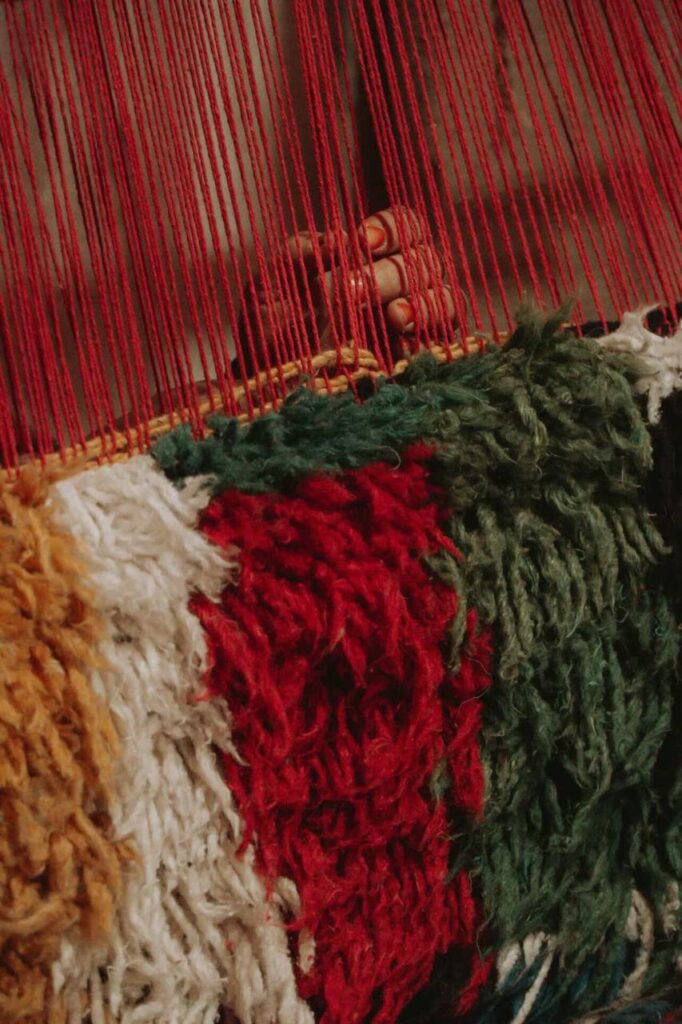
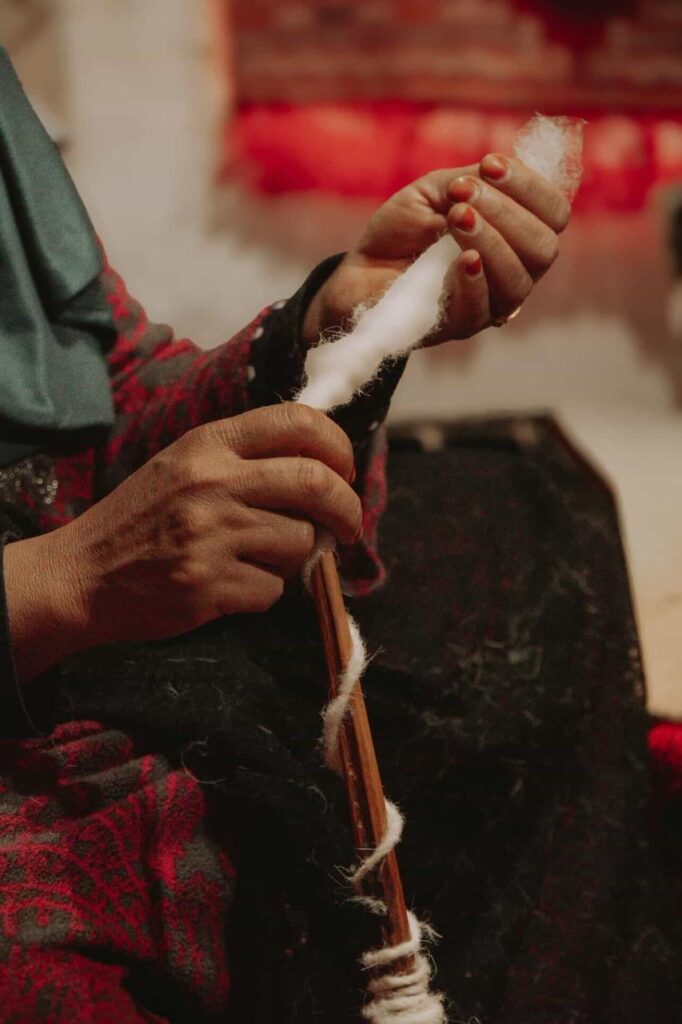
There’s a particular magic that unfolds when you step barefoot onto a handmade Moroccan rug for the first time. It’s not merely the sensation of plush, hand-spun wool beneath your toes, nor the captivating geometric patterns that draw your eye—it’s something deeper, more soulful. It’s the whisper of ancient mountain winds, the echo of looms clicking in remote Berber villages, and the tactile memory of a woman’s hands threading generations of cultural wisdom into every single knot.
These aren’t ordinary floor coverings destined to be replaced with the season’s trends. Handmade Moroccan rugs are living textile narratives, emotional landscapes woven in wool and dye, portals into a culture that has fiercely protected its artistic heritage for over a thousand years. When you bring an authentic Moroccan rug into your home, you’re not simply decorating a space—you’re inviting a piece of living history, human connection, and unparalleled craftsmanship to become part of your daily sanctuary.
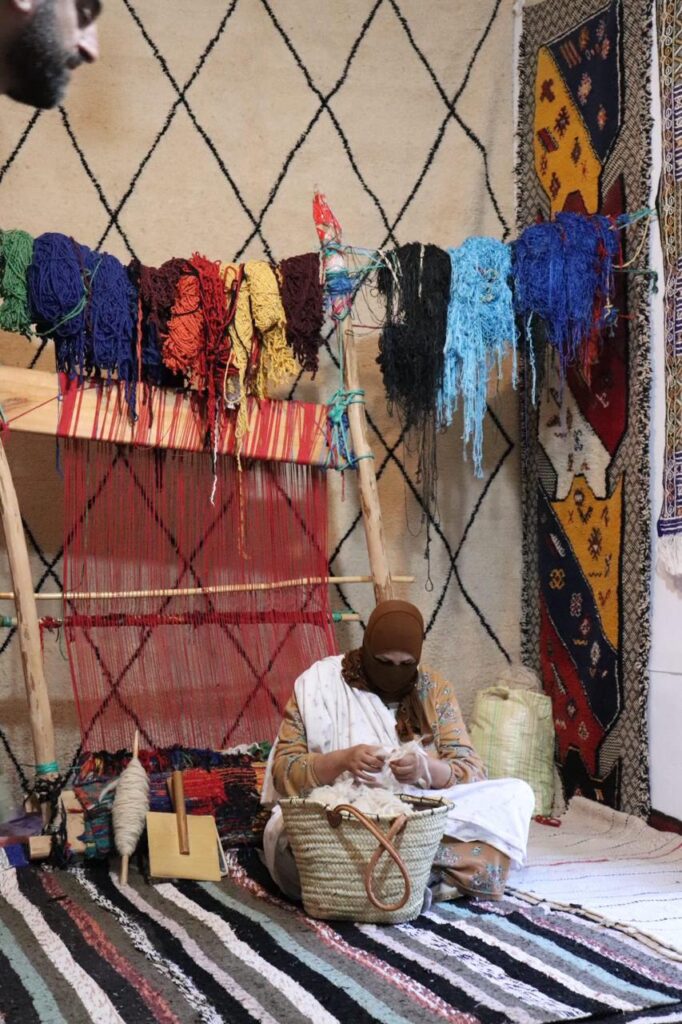
In our contemporary world, increasingly saturated with mass-produced goods and disposable décor, handcrafted Moroccan Berber rugs stand as quiet monuments to patience, artistic integrity, and the irreplaceable value of human touch. Each rug represents not hours, but weeks—sometimes months—of devoted labor. Within its fibers lie the fingerprints of its creator, the cultural DNA of ancient Berber tribes, and the continuation of weaving traditions that UNESCO recognizes as intangible cultural heritage worth preserving for humanity.
This comprehensive guide will take you on an intimate journey through the world of handmade Moroccan rugs—from the windswept Atlas Mountains where sheep graze on wild thyme, to the skilled hands of artisan women transforming raw fleece into functional art, to your own beautifully curated interior spaces. Whether you’re a first-time buyer curious about these captivating textiles or a seasoned collector seeking deeper knowledge, you’ll discover everything you need to appreciate, select, and treasure these remarkable creations.
The Ancient Heritage of Moroccan Berber Rugs: Where Culture Meets Craftsmanship
Long before Morocco became synonymous with vibrant souks, ornate riads, and sun-drenched kasbahs in the Western imagination, the indigenous Berber people—or Amazigh, as they call themselves—roamed the rugged terrain of the Atlas Mountains and Saharan plateaus. These nomadic and semi-nomadic communities developed weaving techniques that would eventually become some of the world’s most sought-after textile traditions.
The story of traditional Moroccan weaving doesn’t begin with luxury or commerce. It begins with survival and necessity. Berber tribes created rugs not as decorative luxury items for palaces, but as essential survival tools for their harsh environment—thick pile for warmth against brutal mountain winters, soft bedding in austere tent dwellings, and transportable wealth that could travel with migratory families across challenging terrains.
The Berber Tribes: Guardians of Weaving Traditions
What makes Moroccan Berber rugs so uniquely captivating is their authentic, unfiltered voice. Unlike the formalized patterns of Persian rugs with their documented symbolism, or Turkish kilims with their mathematically precise geometric designs, Berber rugs speak a more intimate, spontaneous, deeply personal language. They’re abstract expressions of the weaver’s inner landscape—her dreams, fears, daily observations, spiritual beliefs, and lived experiences translated into symbols and patterns that follow no written codex or formal design manual.
Different Berber tribes developed distinct weaving styles, each reflecting their geographic region, climate needs, and cultural aesthetics:
- Beni Ourain: From the Middle Atlas Mountains, famous for their minimalist ivory rugs with simple geometric patterns in charcoal or black—the Beni Ourain collection has become synonymous with contemporary Moroccan design
- Azilal: High Atlas mountain weavers known for vibrant, almost psychedelic abstract patterns combining brilliant colors with spontaneous, painterly compositions—explore our Azilal rug selection
- Boucherouite: Textile recyclers who transform fabric scraps into rainbow-hued, textured compositions, representing the ultimate sustainable folk art—discover Boucherouite pieces
- Beni Mguild: Creators of thick, densely knotted rugs with bold tribal motifs, often featuring rich reds, oranges, and purples from natural dyes
- Zanafi: Flat-weave specialists producing durable, graphic kilims with striking black and white or multicolored diamond patterns
- Mrirt: Mountain tribe known for shaggy, high-pile rugs with protective, talismanic symbols woven into plush wool
Each tribal style carries its own aesthetic signature, yet all share common threads: they’re created entirely by hand, reflect the individual weaver’s creative vision, and serve as cultural repositories of Berber identity, history, and worldview.
The Sacred Symbolism Woven Into Every Thread
Walk through any collection of authentic Moroccan rugs, and you’ll notice certain motifs appearing repeatedly across different tribal styles. These aren’t arbitrary decorative elements—they’re a visual language developed over millennia, carrying meanings both universal and intensely personal.
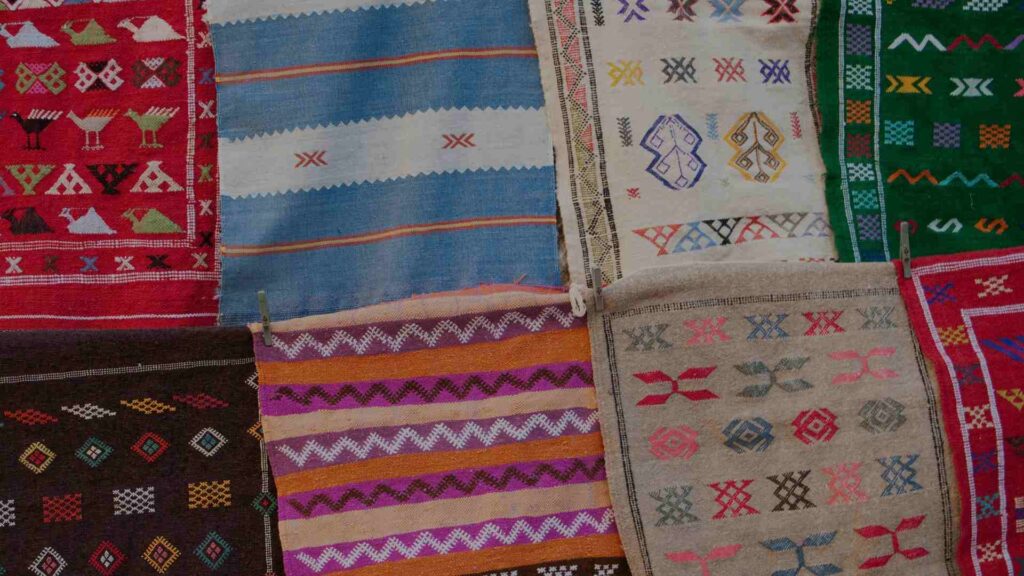
A diamond shape might represent the feminine principle, the evil eye that protects against misfortune, or the cycle of life, death, and rebirth. Zigzag lines often symbolize water—precious and life-giving in arid landscapes—or the serpent, representing wisdom and transformation. Cross-hatching can reference the traditional Berber tattoos that once marked significant life transitions for young women. Scattered checkerboard patterns might represent the barley fields essential to survival, while abstract eye motifs serve as protective talismans watching over the home.
But here’s what makes these symbolic systems genuinely special and frustratingly elusive for pattern-seeking Westerners: no weaver will provide you with a definitive translation of her symbols. The visual vocabulary of traditional Moroccan weaving is intentionally fluid, often subconscious, and deeply personal. As renowned textile scholar documented in museum collections, these women aren’t consulting design templates or replicating commercial patterns from books. They’re creating spontaneous textile poetry, allowing their hands to channel emotions, memories, and ancestral knowledge into knots and pile through a process that’s almost meditative.
Some symbols carry agreed-upon tribal meanings. Others are the private language between a woman and her loom. Many weavers report that they don’t consciously plan their patterns—they simply begin weaving, and the design emerges organically, guided by intuition, muscle memory, and something they can’t quite articulate. This spontaneity is precisely what makes each handmade Moroccan rug an unrepeatable work of art rather than a reproducible commodity.
Understanding Traditional Moroccan Weaving: The Sacred Technique Behind the Beauty
The creation of an authentic Moroccan rug is nothing short of a meditation in wool, patience, and cultural memory. The journey doesn’t begin at the loom—it starts months earlier, in the mountain pastures and valleys where sheep graze on wild herbs, grasses, and flowers that will subtly influence the wool’s texture, color, and quality.
From Mountain Pasture to Artisan Hands: The Complete Wool Journey
The sheep of Morocco—particularly the prized Beni Ourain breed that roams the Middle Atlas—produce wool with exceptional characteristics. Unlike industrially raised sheep fed controlled diets in confined spaces, these animals live semi-wild lives, developing fleece that’s naturally soft, resilient, and infused with high lanolin content that provides natural stain and water resistance.
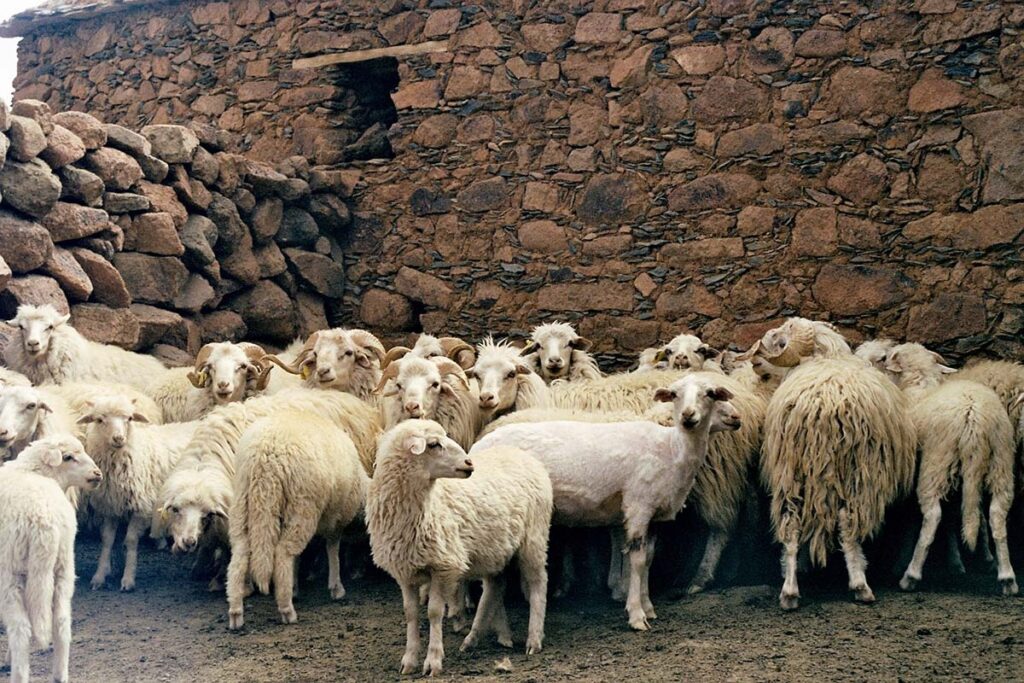
Every spring, during the traditional shearing season, extended families gather for this essential ritual. The fleece is harvested using methods passed down through countless generations, with experienced hands knowing exactly how to shear without stressing the animal or damaging the wool’s integrity. This isn’t the mechanized, industrial wool processing of commercial textile factories—it’s an intimate, seasonal rhythm that connects communities to their animals and their land.
After shearing, the raw fleece undergoes washing, traditionally in nearby rivers or natural springs using techniques that preserve the wool’s beneficial natural oils. Modern artisan cooperatives may use mild, eco-friendly soaps, but the principle remains unchanged: gentle, chemical-free processing that maintains the fiber’s inherent qualities rather than stripping and then artificially treating it.
Carding, Spinning, and the Art of Hand-Spun Yarn
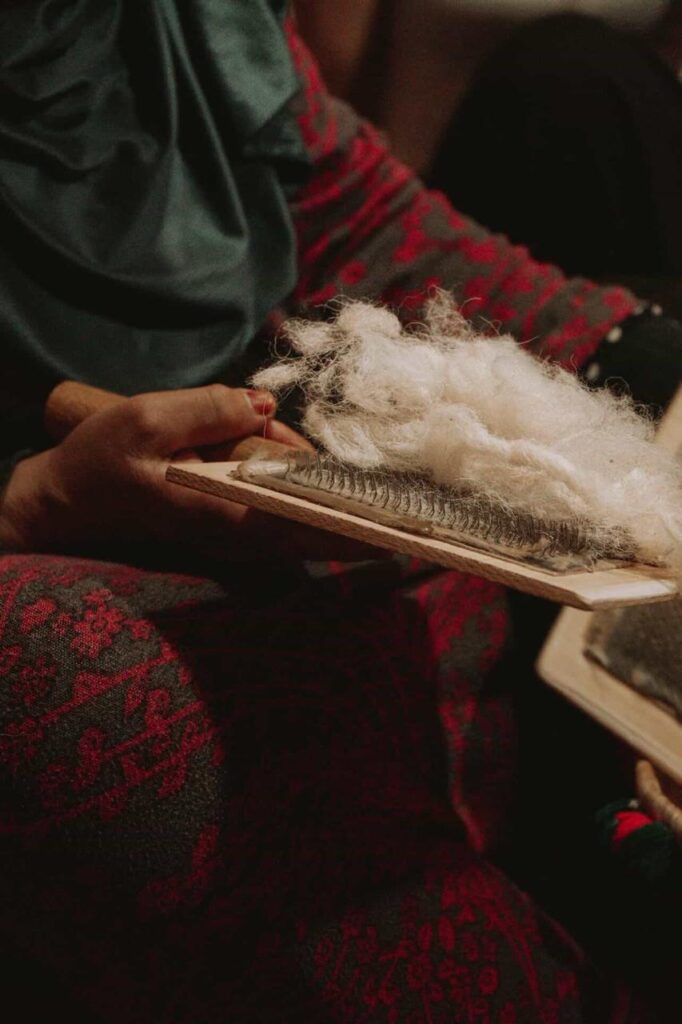
Next comes carding—the process of aligning the wool fibers to prepare them for spinning. Artisan women use hand carders (resembling large paddle brushes with metal teeth) to brush and organize the fluffy fleece into manageable clouds of aligned fiber. This tactile, time-intensive process can’t be rushed; proper carding determines the eventual yarn’s quality, consistency, and strength.
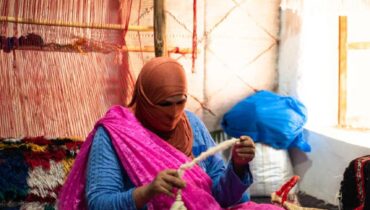
The spinning itself is where individual artisan skill becomes unmistakably apparent. Using simple drop spindles—essentially a weighted stick that uses gravity and rotation to twist fibers into yarn—skilled spinners create thread with remarkable consistency. Watch a Berber woman spin wool, and you’ll witness a rhythm so fluid it appears almost automatic, the result of muscle memory built over decades of daily practice, often beginning in childhood.
The yarn that emerges from this hand-spinning process possesses an irregularly beautiful quality that machine-spun yarn can never replicate. Slight variations in thickness give the finished rug its characteristic texture, visual depth, and unmistakable handmade authenticity. These “imperfections” aren’t flaws—they’re signatures of human hands and individual artisan rhythm.
The Alchemy of Color: Natural and Synthetic Dyes
Color in Moroccan Berber rugs comes from two primary sources, each with its own aesthetic and practical considerations.
Natural, Undyed Wool: Many of the most iconic Moroccan rugs—particularly Beni Ourain styles—celebrate wool in its natural state. Moroccan sheep produce fleece in a beautiful range of organic tones: luminous ivories, warm creams, soft grays, rich chocolates, and deep charcoal blacks. These colors require no processing, carry no environmental impact from dyeing, and develop a beautiful patina as they age, becoming richer and more lustrous over decades.
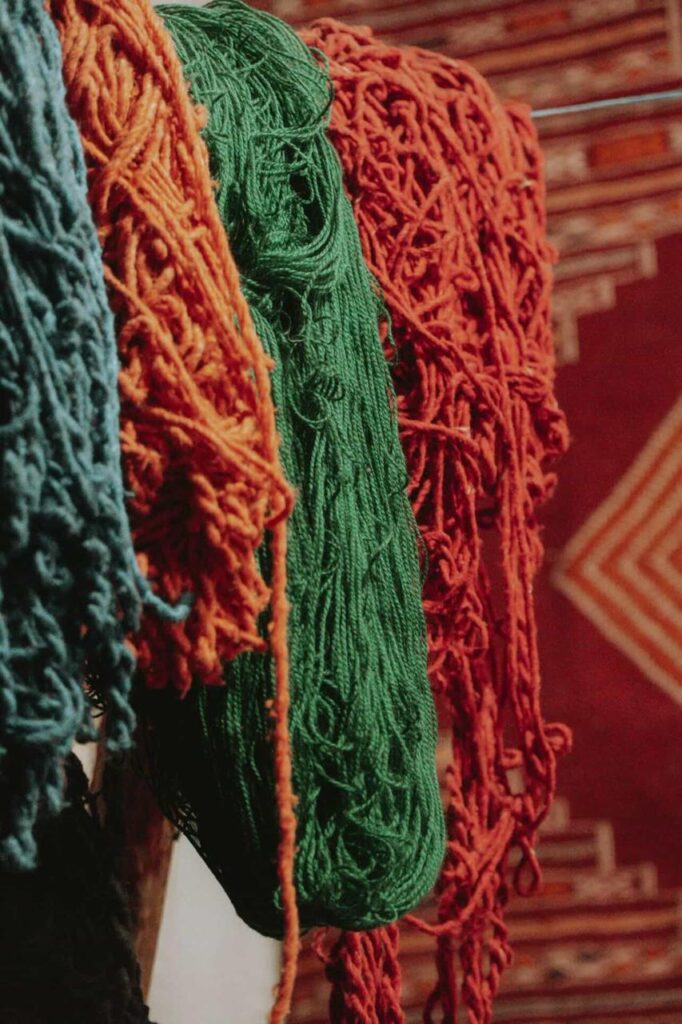
Natural Plant-Based Dyes: Traditional Berber dyers extracted colors from their environment—saffron and turmeric for yellows, pomegranate rinds for golds, indigo for blues, madder root for reds, henna for oranges, and walnut hulls for browns. These natural dyes create subtle, complex colors that shift beautifully in different lighting and fade gracefully over time, developing what textile collectors call “abrash”—gentle color variations that add depth and character.
High-Quality Synthetic Dyes: While purists often seek exclusively natural dyes, many contemporary Berber weavers have embraced modern synthetic dyes, and for valid reasons. Quality synthetic dyes offer color consistency, excellent lightfastness (resistance to fading from sun exposure), and access to vibrant hues difficult or impossible to achieve with natural materials. The spectacular electric blues, sunny yellows, and passionate reds in many Azilal rugs come from synthetic dyes, creating pieces that honor traditional design sensibilities while embracing contemporary color palettes.
According to textile conservation experts at the Smithsonian Institution, what matters most isn’t whether dyes are natural or synthetic, but rather the overall quality, colorfastness, and aesthetic integrity of the finished piece.
The Loom: Where Vision Transforms Into Woven Reality
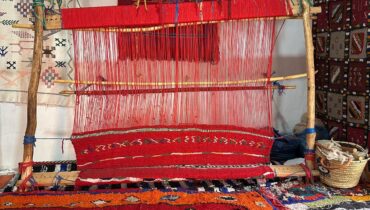
The vertical loom used in most Berber weaving is deceptively simple in construction—wooden beams, basic heddles for creating sheds between warp threads, and not much else. Yet in the skilled hands of a master weaver, this humble tool becomes an instrument of extraordinary artistic expression capable of producing textiles that grace museum collections and luxury homes worldwide.
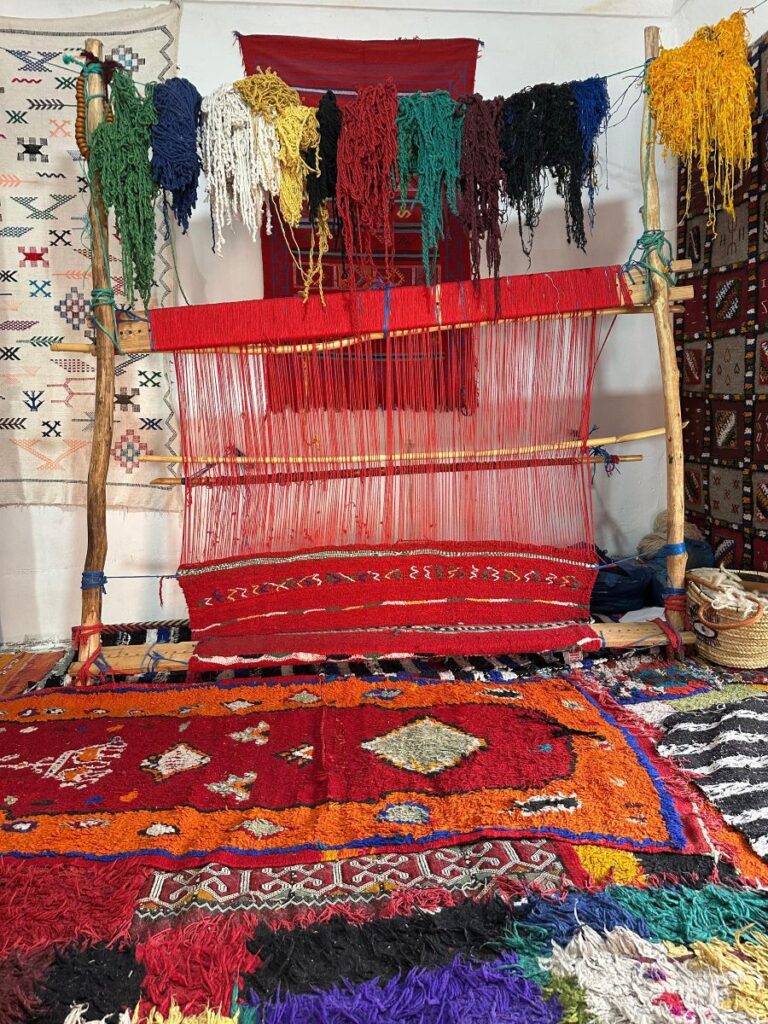
Unlike machine-tufted or industrially produced rugs, authentic handmade Moroccan rugs are constructed knot by individual knot, row by painstaking row. The weaver sits before her loom—sometimes for six to eight hours daily—tying each knot by hand, beating down the weft threads with a heavy comb, and making countless micro-decisions about color, pattern, and texture in real-time.
There are no graph-paper patterns to follow. No color-coded computer printouts. No commercial design templates. Just the weaver, her wool, her cultural inheritance, and whatever creative impulse moves through her fingers that particular day. This spontaneous, improvisational approach to traditional Moroccan weaving means that even rugs from the same weaver will never be identical. Each represents an unrepeatable moment of creative flow, a unique intersection of mood, inspiration, and circumstance, frozen forever in knotted wool.
Different regions employ slightly different knotting techniques. Some use symmetrical Turkish/Ghiordes knots, others asymmetrical Persian/Senneh knots. Pile height varies by tribal tradition and intended use—thick, plush pile for cold mountain regions, lower pile or flat-weave for warmer areas or higher-traffic applications. The density of knots per square inch affects both durability and detail—finer knotting allows more intricate patterns but requires exponentially more time.
The Timeline: Understanding the Investment of Time
One of the most important factors in appreciating authentic Moroccan rugs is understanding the extraordinary time investment each piece represents. This isn’t a quick weekend craft project—it’s a substantial commitment of human life hours.
A small rug (approximately 3×5 feet) with medium pile might require 2-4 weeks of full-time work. A medium-sized piece (5×8 feet) could demand 2-3 months of dedicated weaving. Large rugs (8×10 feet and beyond) can require anywhere from 4-6 months to over a year of work, depending on pile height and pattern complexity. Vintage museum-quality pieces sometimes represent 18 months or more of a weaver’s life.
And remember—many weavers don’t work full-time at their looms. They’re also mothers, homemakers, farmers, and community members with multiple responsibilities. A rug representing “three months of work” might actually span six months of elapsed time as the weaver balances weaving with life’s other demands.
When you purchase a handmade Moroccan rug, you’re acquiring months of someone’s life, skill, and creative energy—a perspective that fundamentally shifts how we value these textiles compared to mass-produced alternatives.
Moroccan Rug Styles: A Comprehensive Guide to Tribal Designs
One of the most enchanting aspects of Moroccan rug culture is its remarkable diversity. While “Moroccan rug” might conjure a single aesthetic in the uninitiated imagination, the reality encompasses dozens of distinct tribal styles, each with unique characteristics, regional origins, and aesthetic signatures.
Beni Ourain: The Minimalist Icon of Moroccan Weaving
If one Moroccan rug style has captured global design consciousness in recent years, it’s undoubtedly the Beni Ourain. These rugs have become the darlings of interior designers, Instagram influencers, and design publications worldwide—and for excellent reasons.
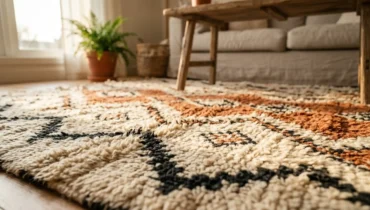
Originating from the Beni Ourain tribes of the Middle Atlas Mountains, these rugs are immediately recognizable: plush, thick ivory or cream pile (often 2-4 inches deep) punctuated by simple geometric patterns in charcoal, black, or dark brown. The designs are admirably restrained—asymmetrical diamonds, scattered lines, abstract symbols—allowing the luxurious texture and neutral palette to take center stage.
The appeal of Beni Ourain rugs lies in their remarkable versatility. They provide warmth, texture, and visual interest without competing for attention in a room’s design scheme. They complement virtually any aesthetic—minimalist Scandinavian, industrial loft, modern farmhouse, traditional colonial, bohemian eclectic—serving as sophisticated anchors that feel simultaneously ancient and utterly contemporary.
Design publications from Architectural Digest to Elle Decor have featured Beni Ourain rugs in countless editorial spreads, cementing their status as a timeless design investment rather than a passing trend.
Authentic Beni Ourain rugs are woven exclusively with natural, undyed wool, celebrating the organic color variations of sheep fleece. The thick pile serves a practical purpose—providing crucial insulation in frigid mountain winters where temperatures regularly drop below freezing. When you sink your feet into an authentic Beni Ourain, you’re experiencing the same luxurious warmth that protected Berber families for centuries.
Boucherouite: Sustainable Textile Art from Recycled Materials
Long before “upcycling” and “sustainable design” became fashionable buzzwords, rural Moroccan women were creating extraordinary textiles from recycled materials out of economic necessity and creative ingenuity. These are Boucherouite rugs—the name derives from the Arabic word for “reused clothing.”
Woven from scraps of cotton fabric, old clothing, textile remnants, and whatever colorful materials were available, Boucherouite pieces represent the ultimate in sustainable, zero-waste textile creation. Rather than wool, weavers use fabric strips, creating a different texture than traditional pile rugs—often flatter, sometimes shaggier depending on materials and technique.
The aesthetic of Boucherouite rugs is wonderfully anarchic and joyful—rainbow explosions of color, unexpected material combinations, wildly spontaneous patterns. Because they’re made from whatever materials are available, no two Boucherouite rugs could possibly be similar, let alone identical. Each is a unique snapshot of what fabrics happened to be accessible in a particular time and place.
Contemporary designers and environmentally conscious consumers have embraced Boucherouite rugs not just for their visual appeal, but for their powerful sustainability narrative. In our current moment of climate crisis and growing awareness about textile waste, these rugs represent circular economy principles that Berber women practiced for generations out of simple resourcefulness.
Vintage and Antique Moroccan Rugs: Investing in History
While newly woven rugs support living artisans and offer pristine condition, vintage and antique Moroccan rugs provide something new pieces cannot: patina, provenance, and the irreplaceable quality of age.
Vintage rugs (generally 20-50 years old) and antiques (50+ years old) carry visible history in their fibers. The pile has been compressed by decades of footsteps. Natural dyes have mellowed and shifted. Edges may show gentle wear. These aren’t flaws—they’re beauty marks, evidence of a rug that has lived, been loved, and survived.
Older rugs also often feature superior wool quality. Decades ago, sheep genetics hadn’t been optimized for industrial meat production at the expense of fleece quality. Weaving was still the primary livelihood for many rural women, incentivizing exceptional craftsmanship. Natural dyes were more common. The result: vintage pieces frequently exhibit quality difficult to find in contemporary production.
For collectors, vintage Moroccan rugs represent both aesthetic investments and cultural preservation. Each old rug saved from deterioration or disposal is a piece of Berber heritage protected for future generations. Museums worldwide, including the Metropolitan Museum of Art, maintain extensive Moroccan textile collections, recognizing these pieces as significant cultural artifacts worthy of conservation and study.
Runners, Pillows, and Beyond: Moroccan Textiles for Every Space
While large area rugs often steal the spotlight, Moroccan weaving traditions produce textiles in various formats, each suited to different spatial applications.
Moroccan Runners: Perfect for hallways, entryways, or alongside beds, runner rugs bring the same handcrafted authenticity to narrower spaces. Many runners feature continuous patterns that draw the eye along their length, creating visual flow through transitional spaces.
Cushions and Pillows: Smaller weaving projects or pieces created from vintage rug sections, Moroccan pillows add texture and cultural richness to sofas, beds, and seating areas without the commitment of a large rug investment.
Saddle Bags and Wall Hangings: Traditionally functional objects—bags for carrying goods on donkeys, decorative wall pieces—these smaller textiles showcase weaving artistry in gallery-worthy formats perfect for collectors with limited floor space.
Handmade Moroccan Rugs in Contemporary Interior Design: Styling and Inspiration
The remarkable renaissance of handmade Moroccan rugs in contemporary interior design isn’t accidental. These textiles possess an almost magical ability to enhance virtually any aesthetic while adding warmth, texture, cultural depth, and that ineffable quality designers call “soul.”
Styling Moroccan Rugs in Minimalist and Scandinavian Interiors
The pairing of Moroccan rugs—particularly neutral Beni Ourain styles—with minimalist and Scandinavian design has become iconic in the past decade, and the combination works beautifully for several reasons.
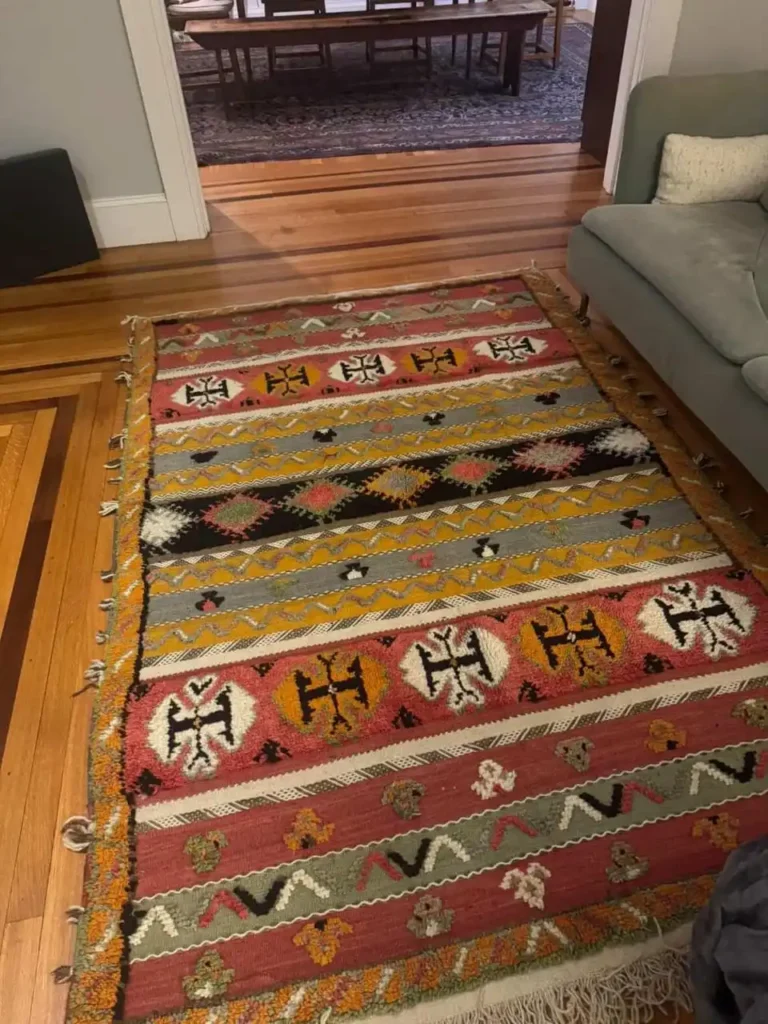
Minimalist spaces can sometimes feel cold, sparse, or overly austere. A plush Beni Ourain rug introduces crucial warmth—both literal thermal comfort and metaphorical emotional warmth—without cluttering the visual field. The neutral palette maintains the color restraint minimalism demands, while the organic wool texture and hand-crafted irregularities prevent the space from feeling too perfect, too sterile, too machine-made.
The slight asymmetries in handmade patterns provide visual interest that rewards close observation while reading as simple and clean from a distance—exactly what minimalist design needs. And the cultural authenticity of a genuine Berber rug adds meaningful depth to spaces that might otherwise feel generic or catalog-derived.
Designer Tips for Minimalist Styling:
- Choose large-scale rugs that anchor seating arrangements rather than small accent pieces
- Allow the rug’s natural texture to be a primary textural element in an otherwise smooth-surfaced room
- Embrace the organic imperfections rather than seeking geometric perfection
- Layer a Moroccan rug over neutral concrete, light wood, or pale tile for tonal sophistication
- Keep surrounding furnishings simple to let the rug’s handcrafted quality shine
Moroccan Rugs in Bohemian and Eclectic Interiors
If Beni Ourain rugs are minimalism’s best friends, colorful Azilal and Boucherouite pieces are bohemian design’s soulmates. These vibrant, personality-packed rugs thrive in maximalist, layered, collected-over-time interiors where more is more and pattern mixing is celebrated.
Bohemian design philosophy embraces global influences, artisan craftsmanship, and personal expression over decorator rules—values perfectly aligned with authentic Moroccan rugs. A vibrant Azilal rug can serve as the color inspiration for an entire room scheme, pulling together seemingly disparate elements through its multi-hued palette.
Styling Strategies for Bohemian Spaces:
- Layer multiple rugs of different sizes, patterns, and textures for dimensional richness
- Pull accent colors from the rug’s palette for throw pillows, artwork, and accessories
- Mix Moroccan rugs with textiles from other global traditions—kilims, suzanis, ikat—for well-traveled eclecticism
- Don’t worry about color coordination perfection; embrace the joyful clash
- Combine vintage and new pieces for collected-over-time authenticity
- Use Moroccan rugs as wall hangings in addition to floor coverings
Modern, Contemporary, and Industrial Interiors
At first glance, handmade tribal textiles and sleek modern or industrial design might seem incompatible. In practice, this contrast creates compelling, sophisticated interiors that feel current without being cold.
In a modern space with clean lines, contemporary furniture, and minimal ornamentation, a handmade Moroccan rug serves as the essential human element—the touch of warmth, history, and imperfection that prevents the room from reading as a showroom. The juxtaposition between ancient handcraft and modern design actually enhances both, creating visual dialogue and layered meaning.
Industrial lofts with exposed brick, concrete floors, and metal fixtures gain crucial softness from Moroccan rugs. The organic wool and handmade irregularities balance the hard, manufactured surfaces, while the cultural heritage adds depth to spaces that might otherwise feel too commercial or warehouse-like.
Modern and Industrial Styling Approaches:
- Use a single statement rug as the room’s organic element amid clean-lined furniture
- Choose geometric Moroccan patterns that echo modern design’s love of abstraction
- Select rugs with graphic black-and-white or limited color palettes for cohesion
- Position rugs to soften hard flooring materials—concrete, tile, polished hardwood
- Allow the contrast between old and new to be deliberate and celebrated
Traditional and Transitional Interiors
While Moroccan rugs have found natural homes in contemporary design, they also work beautifully in traditional interiors—after all, these are traditional textiles with centuries of history. The key is selecting pieces that complement rather than compete with other traditional elements.
In classic, formal rooms, a refined vintage Moroccan rug brings exotic sophistication without disrupting traditional elegance. Choose pieces with more structured patterns, muted or natural color palettes, and excellent condition for spaces where formality matters.
Transitional interiors—those blending traditional and contemporary elements—are perhaps the most natural fit for Moroccan rugs, which themselves bridge ancient tradition and contemporary appeal. A carefully selected Moroccan rug can be the exact element that allows traditional and modern furnishings to coexist harmoniously.
Room-by-Room Placement Guide
Living Rooms: Large rugs that anchor seating areas, with front furniture legs on the rug for cohesion. This is where to invest in your most significant piece—it will receive the most visibility and appreciation.
Bedrooms: Plush, high-pile rugs (especially Beni Ourain styles) provide luxurious comfort for bare feet. Size the rug to extend beyond the bed on three sides, or use runners along each side of the bed.
Dining Rooms: Choose flat-weave or lower-pile rugs that won’t interfere with chair movement. Ensure the rug extends at least 24 inches beyond the table on all sides to accommodate pulled-out chairs.
Entryways and Hallways: Durable runners and flat-weaves in darker or multi-colored patterns that hide dirt. This high-traffic application showcases the practical durability of authentic hand-knotted construction.
Home Offices: Medium-sized rugs that define the work zone and provide comfort underfoot during long work sessions. The handcrafted nature adds warmth to what can otherwise feel like utilitarian spaces.
Bathrooms: Smaller vintage pieces or flat-weaves that can handle moisture and frequent cleaning—though keep valuable rugs away from shower spray and standing water.
The Complete Buyer’s Guide: Choosing Your Perfect Handmade Moroccan Rug
Selecting an authentic Moroccan rug represents a significant investment—not just financially, but emotionally and aesthetically. Unlike purchasing a mass-produced rug that can be reordered if it doesn’t work, choosing a handmade piece means finding the specific rug that speaks to you, knowing that no identical replacement exists.
This section will guide you through the practical considerations, quality assessment, and decision-making process to ensure your rug purchase brings decades of satisfaction.
Determining Authentic Quality: What to Look For
The market for Moroccan rugs includes both genuinely handmade pieces and machine-made imitations. Learning to distinguish authentic quality protects your investment and ensures you’re supporting actual artisans rather than factories producing convincing copies.
Examine the Back: Flip the rug over. In an authentic hand-knotted rug, you should see the pattern clearly mirrored on the reverse side, with individual knots visible. The back will show slight irregularities—evidence of human hands rather than machine precision. Machine-made rugs often have uniform, latex-backed surfaces with no visible individual knots.
Check for Asymmetries: Authentic handmade Moroccan rugs will display subtle imperfections. Edges may not be perfectly straight. Patterns might be slightly asymmetrical. Pile height might vary. These aren’t flaws—they’re authentication markers. Perfect geometric precision suggests machine production.
Assess the Edges and Fringe: Hand-finished edges and fringe should show individual attention. The selvage (side edges) should be wrapped with the warp threads as part of the original weaving, not machine-stitched afterward. Fringe should be the actual warp threads extending from the rug’s foundation, not sewn-on decorative additions.
Feel the Texture: Hand-spun wool has irregular texture—slightly thick and thin variations that create organic character. The pile will feel dense but not uniformly perfect. Natural wool contains lanolin that gives it a subtle waxy feel and distinctive, pleasant smell—quite different from the chemical odor of synthetic fibers.
Examine Knot Density: While knot count varies by tribal tradition and intended use, you should be able to see individual knots with close inspection. Very high knot density (fine knotting) takes longer to create and allows more pattern detail. Lower knot density isn’t inferior—many tribal styles traditionally use more generous knotting—but the knots should still be clearly hand-tied.
Investigate the Materials: Authentic Moroccan rugs use natural wool (occasionally cotton for warp threads in some styles). The wool should feel substantial, springy, and resilient. Test a small inconspicuous area: wool fibers will char and smell like burning hair when exposed to flame briefly; synthetic fibers will melt and smell like burning plastic. (Exercise extreme caution with burn tests and only attempt on designated sample threads if provided.)
Size Selection: Proportion and Spatial Planning
Unlike mass-produced rugs available in standardized sizes, handmade Moroccan rugs come in dimensions determined by traditional loom widths and individual weaver decisions. This means you’re less likely to find a rug in exactly the standard 8×10 or 9×12 you might seek—and that’s perfectly fine.
Moroccan rugs were traditionally woven for Berber homes and tents, not Western living rooms, so their proportions reflect different spatial logic. Embrace this authenticity rather than fighting against it.
Living Room Sizing: For seating areas, ideally all furniture front legs should rest on the rug, or at minimum, the rug should extend 18-24 inches beyond the coffee table on all sides. This creates visual cohesion. However, if you find a spectacular rug in a smaller size, consider using it as an accent piece under just the coffee table—there are no absolute rules.
Bedroom Sizing: Rugs should extend at least 18-24 inches beyond the bed on three sides (both sides and the foot). For king beds, this typically means 8×10 or larger. For queens, 6×9 or 8×10 works well. Alternatively, use matching runners on either side of the bed.
Dining Room Sizing: Add at least 48 inches to your table dimensions to ensure the rug extends 24 inches beyond on all sides, accommodating pulled-out chairs. For a 6-foot table, that means at minimum an 10×10 rug (6 feet + 4 feet = 10 feet).
Runners and Hallways: Runners should span nearly the full length of the hallway, stopping 6-12 inches from each end. Width depends on hallway width but generally 2.5-4 feet for standard residential hallways.
When in doubt, larger is usually better than smaller. A too-small rug can make a room feel fragmented and choppy. A generous rug anchors the space and creates cohesion.
Color Selection: Psychology, Practicality, and Personal Preference
Color choice in Moroccan Berber rugs serves both aesthetic and practical functions. Understanding how different color approaches perform in real-world use helps guide your selection.
Neutral Palettes (Ivory, Cream, Beige, Gray):
- Create serene, calming foundations
- Allow other design elements to be focal points
- Work with virtually any color scheme
- Show wear patterns and stains more readily
- Best for low-traffic areas or households without young children and pets
- Develop beautiful patina as they age
- Never go out of style
Our Beni Ourain collection offers exceptional examples of neutral Moroccan rugs.
Multi-Colored, Vibrant Palettes:
- Become room focal points and conversation pieces
- Inject energy, personality, and visual interest
- Hide everyday dirt, wear, and minor stains remarkably well
- Can inspire entire room color schemes
- Work beautifully in family-friendly, high-traffic applications
- Require more careful coordination with other room elements
- Reflect traditional Moroccan love of bold color
Explore our colorful Azilal and multi-hued collections for vibrant options.
Monochromatic and Limited Palettes:
- Provide visual interest through pattern rather than color
- Offer sophisticated, gallery-like aesthetic
- Work in both traditional and contemporary settings
- Allow texture to be the primary design element
- Create cohesion in complex, pattern-heavy rooms
Pile Height: Comfort, Durability, and Application
Pile height significantly affects both the rug’s aesthetic and its practical performance in different applications.
High Pile (2-4+ inches): Luxuriously plush underfoot, provides excellent insulation, creates dramatic texture. Best for bedrooms, low-traffic living areas, and spaces where comfort is paramount. May be more difficult to vacuum thoroughly and can show vacuum tracks. Traditional in Beni Ourain and Mrirt tribal styles.
Medium Pile (0.5-2 inches): Balances comfort with practicality, easier to clean, suitable for moderate traffic. Works well in family rooms, dining areas, and multi-purpose spaces. The most versatile option for varied household needs.
Low Pile and Flat-Weave (under 0.5 inches): Highly durable, easy to clean, works under furniture and doors without interference. Excellent for high-traffic entryways, dining rooms, kitchens, and utility spaces. Zanafi and kilim styles exemplify this category.
New Versus Vintage: Understanding the Trade-offs
Both newly woven and vintage Moroccan rugs offer distinct advantages, and the “better” choice depends on your priorities and circumstances.
Advantages of Newly Woven Rugs:
- Pristine condition with no wear or damage
- Direct support for living artisans and their families
- Possibility of custom sizes and color requests with some weavers
- Full expected lifespan ahead (potentially 50+ years with proper care)
- Generally lower price point than comparable vintage pieces
- Known provenance and creation date
Advantages of Vintage and Antique Rugs:
- Desirable patina and character impossible to replicate in new pieces
- Often superior wool quality from older sheep breeds
- Historical and cultural significance
- More likely to feature natural dyes (in older pieces)
- Investment potential—quality vintage rugs can appreciate in value
- Proven durability—they’ve already survived decades
- Unique patterns and styles no longer being woven
- Immediate availability without waiting for creation
Considerations for Vintage Rugs:
- May show wear—low pile areas, edge damage, stains, repairs
- Higher price points for quality pieces
- Limited size and color options—you get what exists
- May require professional restoration
- Provenance sometimes uncertain
- Availability limited to existing inventory
Many collectors and enthusiasts ultimately acquire both—investing in new rugs to support contemporary artisans while selectively adding special vintage pieces that offer something new rugs cannot.
Budget Considerations: Understanding Value vs. Price
Authentic handmade Moroccan rugs represent significant investments, with prices ranging from several hundred to several thousand dollars depending on size, age, condition, and rarity. Understanding the factors that influence pricing helps you make informed decisions aligned with your budget.
What Affects Moroccan Rug Pricing:
- Size: Larger rugs require exponentially more materials and time—a rug twice the dimensions requires four times the materials and weaving time
- Knot Density: Finer knotting means more time investment and allows more detailed patterns
- Age and Condition: Vintage pieces in excellent condition command premium prices; antiques even more so
- Tribal Origin: Certain tribal styles (Beni Ourain, for example) have higher market demand
- Rarity: Unusual sizes, rare patterns, or out-of-production styles increase value
- Natural vs. Synthetic Dyes: Naturally dyed rugs often cost more due to labor-intensive dyeing processes
- Source and Supply Chain: Direct artisan relationships vs. multiple intermediaries affects pricing
- Market and Location: Prices vary between Morocco souks, auction houses, and retail galleries
Typical Price Ranges (USD, at reputable retailers):
- Small new rugs (3×5 feet): $300-$800
- Medium new rugs (5×8 feet): $800-$2,000
- Large new rugs (8×10+ feet): $1,500-$5,000+
- Small vintage rugs: $400-$1,200
- Medium vintage rugs: $1,000-$3,500
- Large vintage rugs: $2,000-$8,000+
- Exceptional antiques and collector pieces: $5,000-$25,000+
These prices reflect fair compensation to artisans, quality materials, and authentic handmade construction. Significantly lower prices should raise questions about authenticity, artisan compensation, or quality.
Where to Buy: Ensuring Authenticity and Fair Trade
Where you purchase your handmade Moroccan rug matters enormously—for authenticity assurance, artisan support, and your own satisfaction.
Specialized Online Retailers with Direct Artisan Relationships: Companies like Berber House Rugs work directly with artisan cooperatives and individual weavers in Morocco, ensuring authenticity, fair compensation, and transparent sourcing. Benefits include curated selections, detailed provenance information, and customer support to guide your selection.
Reputable Physical Galleries and Showrooms: Established rug galleries with expertise in Moroccan textiles offer the advantage of seeing and touching pieces in person. Look for galleries with knowledgeable staff, clear sourcing information, and fair return policies.
Artisan Cooperatives in Morocco: If traveling to Morocco, visiting cooperatives allows you to meet weavers, see production firsthand, and purchase directly. However, language barriers, authentication challenges for novice buyers, and shipping logistics can complicate this approach.
Auction Houses and Estate Sales: For vintage and antique collectors, auctions can offer exceptional pieces. However, condition assessment requires expertise, and bidding competition can drive prices beyond retail.
Approaches to Avoid:
- Sellers unwilling or unable to provide origin information
- Prices far below market rates (likely machine-made or misrepresented)
- Vendors with no expertise in Moroccan rugs specifically
- Marketplaces with no authentication standards or buyer protection
- Souk purchases without expert guidance (high risk of overpaying for machine-made pieces)
Supporting Artisan Communities: The Human Impact of Your Purchase
Behind every handmade Moroccan rug stands a woman—and increasingly, a cooperative of women—whose economic security, family wellbeing, and cultural identity are intimately tied to this ancient craft. Understanding the human dimension of your purchase transforms it from a simple transaction into an act of cultural preservation and economic empowerment.
Women Artisans: The True Heart of Moroccan Weaving
Weaving in Berber culture has traditionally been exclusively women’s work—a skill passed from grandmother to mother to daughter through demonstration, practice, and cultural osmosis rather than formal instruction. Young girls begin learning basic techniques as early as age 5 or 6, gradually progressing to more complex patterns and independent weaving by their teenage years.
For many rural Moroccan women, particularly in remote Atlas Mountain villages with limited economic opportunities, weaving provides essential income that would otherwise be unavailable. This isn’t supplemental “hobby” money—it’s often the primary or sole cash income for families living in areas with few employment options beyond subsistence agriculture.
The income from rug weaving pays for critical needs:
- Children’s education, school supplies, and fees
- Healthcare and medical expenses
- Home improvements and basic infrastructure
- Food security and dietary diversity
- Economic independence and decision-making power within families
- Savings for emergencies and future needs
Beyond economic impact, weaving provides cultural continuity, social connection, and personal identity. For many weavers, time at the loom represents creative expression, meditative practice, and connection to ancestral traditions—value that transcends monetary compensation.
The Role of Weaving Cooperatives
In recent decades, many Berber weaving communities have organized into cooperatives—collective organizations that provide structure, support, and fair market access for member artisans.
Well-functioning cooperatives offer members:
- Fair, transparent pricing: Compensation based on time, skill, and materials rather than exploitative souk bargaining
- Reliable markets: Consistent buyers rather than dependency on tourist traffic
- Quality materials: Bulk purchasing of wool, dyes, and supplies at better prices
- Skill development: Training in traditional techniques, natural dying, and quality standards
- Community infrastructure: Shared workspace, childcare, literacy programs, and social support
- Collective bargaining power: Stronger negotiating position with wholesalers and retailers
- Cultural preservation: Intentional transmission of traditional techniques to younger generations
Organizations committed to ethical sourcing, like Berber House Rugs, prioritize cooperative partnerships that ensure fair compensation and sustainable livelihoods for weaving communities.
The Threat to Traditional Weaving
Despite growing international appreciation for authentic Moroccan rugs, traditional weaving faces genuine threats to its survival:
Economic pressure: Mass-produced imitations undercut artisan prices, making it difficult for weavers to earn living wages. When a machine-made “Moroccan-style” rug sells for $200, consumers may balk at paying $2,000 for an authentic handmade piece—despite the enormous difference in labor, materials, and cultural value.
Generational discontinuity: Young women increasingly seek education and urban employment rather than continuing weaving traditions. This isn’t inherently negative—education and opportunity are positive developments—but without intentional cultural preservation efforts, weaving knowledge accumulated over millennia could vanish within a generation or two.
Environmental and social change: Climate change affects wool quality and availability. Modernization disrupts traditional pastoral lifestyles. Urbanization depopulates rural weaving communities. Each change adds stress to already fragile cultural transmission.
How Your Purchase Makes a Difference
When you invest in an authentic handmade Moroccan rug from an ethical source:
- You provide direct income to artisan families—often representing a month or more of earnings from a single rug
- You demonstrate market demand for authentic handcraft, incentivizing young women to continue traditional skills
- You support cooperative infrastructure that provides community benefits beyond individual income
- You help preserve intangible cultural heritage recognized by UNESCO as worth protecting
- You vote with your wallet against exploitative labor practices and environmental damage inherent in mass production
- You create demand that supports entire rural economies dependent on textile crafts
This is why authenticity matters—not as abstract purism, but as economic justice and cultural preservation. Every authentic rug purchased supports the continuation of traditions that have survived centuries of change. Every imitation purchased undermines that continuation.
Caring for Your Investment: Maintenance, Cleaning, and Long-Term Preservation
One of the most compelling aspects of authentic Moroccan rugs is their remarkable durability. With appropriate care, these pieces can last for generations—literally becoming family heirlooms that improve with age, developing character and patina that only enhance their beauty.
Proper maintenance isn’t complicated or time-intensive, but it does require understanding the specific needs of natural wool and hand-knotted construction.
Routine Maintenance: Daily and Weekly Care
Regular Vacuuming: Vacuum your rug weekly (more frequently in high-traffic areas) to remove surface dirt and prevent it from settling deep into the pile. Use suction-only settings—turn off rotating beater bars/brush rolls that can damage hand-knotted fibers and pull out individual knots over time. For high-pile rugs, vacuum in the direction of the pile rather than against it.
Rotation: Every 3-6 months, rotate your rug 180 degrees to ensure even wear patterns and sun exposure. This simple practice prevents one area from developing significantly more wear than others, extending the rug’s life and maintaining visual consistency.
Shake and Air: For smaller rugs (under 5×7), take them outside periodically and shake vigorously or beat gently with a rug beater to dislodge embedded dust and refresh the fibers. Airing rugs outside (in shade, not direct sun) for a few hours can naturally deodorize and refresh them.
Furniture Pad Protection: Use felt pads under furniture legs resting on rugs to prevent crushing and indentation of pile. Periodically move furniture slightly to prevent permanent compression patterns.
Sunlight Management: While moderate indirect sunlight won’t harm quality rugs, intense direct sun can fade natural dyes over time. Use window treatments during peak sun hours if your rug receives strong direct sunlight, or accept gentle fading as part of the rug’s aging character—many collectors appreciate sun-faded vintage pieces.
Spot Cleaning and Stain Treatment
Accidents happen. When they do, quick action and proper technique minimize damage.
Immediate Response: Blot spills immediately using clean white cloths or paper towels—never rub or scrub, which spreads the stain and damages fibers. Blot from the outside of the spill toward the center to prevent spreading.
Water-Based Spills (coffee, wine, juice): After blotting up excess liquid, use cold water (never hot, which can set stains) and continue blotting. For stubborn stains, mix a tiny amount of wool-safe detergent with cold water, apply sparingly to the stain (not soaking the rug), and blot. Rinse with cold water and blot dry. Allow to air dry completely.
Oil-Based Stains (grease, oil): Sprinkle cornstarch or baking soda on the stain to absorb oil, let sit for several hours, then vacuum. For persistent oil stains, professional cleaning is safer than attempting home treatment with solvents that might damage dyes or fibers.
Mud and Dirt: Allow mud to dry completely, then vacuum or brush away dried particles. Resist the urge to wet-clean fresh mud, which spreads the stain.
Pet Accidents: Blot thoroughly, then use an enzymatic pet stain remover designed for natural fibers. Test in an inconspicuous area first. The natural lanolin in wool actually provides some stain resistance, and many pet stains can be successfully removed if treated promptly.
What to Avoid:
- Harsh chemicals, bleach, or strong detergents
- Steam cleaners (excessive moisture can damage backing and promote mildew)
- Over-wetting (wool takes a long time to dry and can develop mildew)
- Rubbing or scrubbing (damages fibers and spreads stains)
- Hot water (can set stains and affect dyes)
Professional Cleaning: When and How
Every 1-3 years (depending on traffic and use), have your handmade Moroccan rug professionally cleaned by specialists experienced with hand-knotted textiles. This isn’t the same as general carpet cleaning—it requires specific expertise.
Finding a Qualified Cleaner: Look for cleaning services specializing in Oriental and hand-knotted rugs. Ask about their process—proper cleaning involves:
- Thorough dusting (often using special dusting machines)
- Hand washing with pH-balanced, wool-safe solutions
- Careful drying in controlled conditions
- No steam cleaning or harsh chemicals
- Experience with natural dyes (which require gentler treatment than synthetic dyes)
Professional cleaning revitalizes colors, removes deep-seated dirt, eliminates odors, and can extend your rug’s lifespan by decades. It’s an investment in preservation rather than an expense.
Storage: Protecting Rugs Not in Use
If you need to store your Moroccan rug seasonally or during moves:
Cleaning First: Never store a dirty rug—soil and stains worsen over time in storage and attract pests. Have the rug professionally cleaned before storage.
Rolling, Not Folding: Roll the rug loosely with the pile facing inward to prevent creasing and pile distortion. Never fold, which creates permanent creases and stresses fibers.
Wrapping: Wrap the rolled rug in clean, breathable cotton muslin or a cotton sheet. Never use plastic, which traps moisture and promotes mildew growth. Wool needs to breathe.
Pest Protection: Add cedar blocks, dried lavender, or moth-repellent sachets (avoid mothballs, which smell terrible and contain harmful chemicals). Inspect stored rugs every few months.
Storage Location: Choose a cool, dry, climate-controlled location away from direct sunlight, moisture, and temperature extremes. Avoid damp basements and hot attics. Store horizontally if possible, or vertically if rolled diameter is large.
Avoid:
- Storing dirty rugs
- Plastic wrapping or bags
- Damp or humid locations
- Direct contact with concrete (which can trap moisture)
- Tight rolling (can stress backing and fibers)
- Storage for years without periodic inspection
Repair and Restoration: Extending Life Through Expert Care
Quality handmade Moroccan rugs can be repaired, restored, and preserved even after decades of use. Proper restoration can add decades to a rug’s life and maintain its value.
Common Repair Needs:
- Edge and binding repair (common wear area)
- Reweaving of damaged or moth-eaten areas
- Fringe repair or replacement
- Backing reinforcement
- Color restoration for faded areas
Seek specialists in hand-knotted rug repair—this is skilled artisan work requiring training and experience. Quality restoration is expensive but worthwhile for valuable rugs. Minor repairs cost $100-500; extensive restoration can run into thousands, but preserves rugs worth significantly more.
The Investment Perspective: Value, Appreciation, and Legacy
While the primary value of handmade Moroccan rugs is aesthetic, cultural, and experiential, these pieces can also represent sound financial investments—particularly quality vintage and antique examples from sought-after tribal origins.
Market Trends and Collector Interest
The market for authentic Moroccan tribal rugs has grown substantially over the past two decades, driven by:
- Increased global awareness of Berber weaving traditions
- Interior design trends favoring artisan, handmade goods
- Growing collector interest in tribal textiles as art
- Limited supply of quality vintage pieces as they’re acquired and held
- Rising appreciation for ethical, sustainable home goods
Rare, exceptional examples have sold at major auction houses like Christie’s and Sotheby’s for five and even six figures. While most Moroccan Berber rugs won’t reach such rarified heights, quality pieces from reputable sources generally maintain or appreciate in value, particularly:
- Vintage and antique pieces in excellent condition
- Rugs from specific sought-after tribes (Beni Ourain, certain Azilal, rare Ait Khozema)
- Larger sizes (more rare in authentic pieces)
- Exceptional, unusual, or particularly beautiful examples
- Pieces with documented provenance
- Naturally dyed vintage rugs
Comparing Investment Value: Handmade vs. Machine-Made
The financial comparison between authentic handmade rugs and machine-made alternatives becomes clear over time:
Machine-Made Rugs:
- Lower initial cost
- Rapid depreciation (near-zero resale value)
- Shorter lifespan (5-10 years typical)
- Requires replacement, creating recurring cost
- No cultural, historical, or collector value
- Zero investment potential
Handmade Moroccan Rugs:
- Higher initial investment
- Maintain or appreciate in value
- Multi-generational lifespan (50-100+ years)
- One-time purchase becomes long-term asset
- Cultural and artistic value increases over time
- Can be sold, often for more than purchase price
Viewed over a 20-30 year horizon, a $2,000 investment in a quality handmade Moroccan rug costs less per year than repeatedly replacing $300 machine-made rugs every 5-7 years, while also providing superior aesthetics, comfort, and potential resale value.
Beyond Financial Value: The Heirloom Perspective
Perhaps the most meaningful investment dimension of authentic Moroccan rugs isn’t financial at all—it’s the creation of family legacy and connection to human heritage.
These rugs become repositories of family memory. Children take their first steps on them. Family gatherings happen around them. They witness daily life across decades, absorbing the energy, stories, and moments that constitute a life well-lived.
When you pass a quality Moroccan rug to the next generation, you’re transmitting not just a beautiful object, but a tangible connection to:
- The artisan who created it
- The cultural traditions it represents
- Your own taste, values, and life experiences
- Appreciation for quality, craft, and authenticity
This intergenerational value—impossible to quantify financially—may ultimately be the most compelling investment argument of all.
Frequently Asked Questions About Handmade Moroccan Rugs
How can I definitively tell if a Moroccan rug is authentically handmade?
Examine several key indicators: First, flip the rug over—authentic hand-knotted rugs show the pattern clearly mirrored on the back with visible individual knots and slight irregularities. Machine-made rugs typically have uniform, latex-backed surfaces. Second, look for asymmetries and “imperfections” in the pattern, edge straightness, and pile consistency—these are signatures of human hands. Third, check edges and fringe—they should be hand-finished as part of the original weaving, not machine-stitched. Fourth, feel the texture—hand-spun wool has organic variations, and natural wool contains lanolin giving it a distinctive pleasant smell, quite different from synthetic fibers’ chemical odor. Finally, examine knot density—you should be able to see individual hand-tied knots upon close inspection. When purchasing from reputable sellers, authenticity guarantees provide additional assurance.
What makes Beni Ourain rugs so expensive compared to other Moroccan styles?
Several factors contribute to Beni Ourain pricing: First, they require exceptionally high-quality wool from specific Middle Atlas sheep breeds, which produces the characteristic plush, thick pile. Second, the deep pile height (often 2-4 inches) requires substantially more wool and weaving time than lower-pile styles. Third, market demand has increased significantly as they’ve become iconic in contemporary interior design, affecting pricing. Fourth, authentic Beni Ourain rugs use only natural, undyed wool in its premium state. Finally, the tribal weaving tradition requires specific skills passed through generations. While Beni Ourain rugs are often among the higher-priced Moroccan styles, other factors like size, age, and condition affect individual rug pricing more than tribal origin alone.
Are handmade Moroccan rugs practical for homes with children, pets, and heavy use?
Absolutely—in fact, authentic handmade Moroccan rugs often outperform machine-made alternatives in active households. The hand-knotted construction creates exceptional durability that withstands heavy traffic. Natural wool contains lanolin, providing inherent stain and water resistance superior to synthetic fibers. The dense knotting prevents shedding and deterioration even with daily use. For family-friendly applications, choose multi-colored or darker patterns that camouflage everyday wear, consider medium or low-pile heights for easier cleaning, and select durable tribal styles like Azilal or flat-weave Zanafi. Many families find their Moroccan rugs outlast multiple machine-made replacements while developing beautiful patina rather than simply looking worn. With appropriate care—regular vacuuming and prompt stain treatment—these rugs easily handle real-world family life while maintaining their beauty for generations.
How long does it actually take to create a handmade Moroccan rug?
The creation timeline varies dramatically based on size, pile height, knot density, and pattern complexity. A small 3×5 foot rug with medium pile typically requires 2-4 weeks of full-time weaving (approximately 150-300 hours). A medium 5×8 foot piece might demand 2-3 months (300-600 hours). Large 8×10 foot rugs can require 4-6 months or more (600-1,200+ hours), with some exceptional pieces representing over a year of work. However, these timeframes assume full-time weaving. Most artisan weavers balance weaving with other responsibilities—childcare, household management, agriculture—so a rug representing “three months of work” might actually span six months of calendar time. High-pile rugs like Beni Ourain take longer than flat-weaves. Finer knotting increases time exponentially. This substantial time investment—often hundreds or thousands of human hours per rug—fundamentally differentiates authentic handmade pieces from machine production.
Do new Moroccan rugs shed, and should I be concerned?
Initial shedding in new wool rugs is completely normal and actually indicates quality natural fibers. The shedding consists of short loose fibers—remnants from the spinning and weaving process that weren’t fully integrated into the rug’s structure. This is similar to a new wool sweater releasing some fibers initially. Regular vacuuming during the first few weeks or months will minimize visible shedding, and the amount will decrease significantly after this break-in period. Most shedding resolves within 2-6 months depending on pile height and traffic. Vintage rugs have typically already completed this process. If a rug continues heavy shedding beyond the initial months, it may indicate lower-quality wool or construction issues worth addressing with your seller. The shedding shouldn’t affect the rug’s structural integrity—the actual knotted pile remains secure. Simply vacuum regularly during the initial period, and don’t be alarmed by the loose fibers you see—they’re a temporary characteristic of new natural wool rugs.
What should I realistically expect to pay for an authentic handmade Moroccan rug?
Pricing reflects size, age, tribal origin, condition, and quality. For newly woven rugs from ethical sources providing fair artisan compensation: small rugs (3×5 feet) typically range $300-$800; medium sizes (5×8 feet) generally cost $800-$2,000; large pieces (8×10 feet and up) run $1,500-$5,000 or more. Vintage rugs command premiums: small vintage pieces $400-$1,200; medium vintage $1,000-$3,500; large vintage $2,000-$8,000+. Exceptional antiques, rare tribal pieces, and museum-quality rugs can reach $10,000-$25,000+. These prices reflect months of human labor, quality natural materials, and fair compensation to artisan weavers. Significantly lower prices (new “Moroccan” rugs under $200-300) almost certainly indicate machine production, synthetic materials, or exploitative labor practices. When purchasing from reputable dealers, you’re investing in authentic craftsmanship, supporting artisan livelihoods, and acquiring a piece that will last for generations—making the cost-per-year of ownership very reasonable compared to repeatedly replacing cheap alternatives.
How do I clean and maintain my Moroccan rug to ensure it lasts for generations?
Proper maintenance isn’t complicated but requires consistency: Vacuum weekly using suction-only settings (no beater bars that damage hand-knotted fibers). Rotate the rug 180 degrees every 3-6 months to ensure even wear and sun exposure. For spills, blot immediately with white cloths—never rub. Use cold water and minimal wool-safe detergent for water-based stains; consider professional treatment for oil-based stains. Every 1-3 years, have the rug professionally cleaned by specialists experienced with hand-knotted textiles—proper cleaning revitalizes colors and removes deep dirt, extending lifespan significantly. Avoid steam cleaning, harsh chemicals, over-wetting, and excessive direct sunlight. Use furniture pads under legs to prevent pile compression. For storage, clean first, roll (never fold) with pile facing inward, wrap in breathable cotton (never plastic), and store in cool, dry, climate-controlled locations. With this straightforward care regimen, quality handmade Moroccan rugs easily last 50-100+ years, often improving with age as they develop beautiful patina. Many of the vintage pieces available today have already survived 50+ years and will continue for decades more with continued proper care.
What’s the difference between naturally dyed and synthetically dyed Moroccan rugs?
Natural dyes, extracted from plants, insects, and minerals (indigo, madder root, saffron, pomegranate, walnut), create subtle, complex colors that shift beautifully in different lighting and fade gracefully over time, developing what collectors call “abrash”—gentle color variations that add depth. They carry historical authenticity and environmental benefits but can be less colorfast and offer limited color range. Synthetic dyes provide consistent, vibrant colors (especially bright blues, fuchsias, and yellows difficult to achieve naturally), excellent lightfastness, and broader palette options. Quality synthetic dyes used by contemporary Berber weavers are safe, stable, and allow creative color exploration while maintaining traditional designs. According to textile experts at institutions like the Smithsonian, what matters most isn’t whether dyes are natural or synthetic, but overall quality, colorfastness, and aesthetic integrity. Many collectors prize naturally dyed vintage rugs for their historical authenticity, while others appreciate the creative vibrancy synthetic dyes enable in contemporary pieces. Both approaches have merit; choose based on your aesthetic preferences and practical needs rather than assuming one is inherently superior.
Can I find Moroccan rugs in custom sizes, or am I limited to existing inventory?
Moroccan rugs are typically woven in sizes determined by traditional loom widths and individual weaver decisions rather than standardized Western dimensions, so finding an exact match to standard room sizes may require flexibility. However, some options exist for custom sizing: First, some reputable dealers work with artisan cooperatives willing to accept custom commissions for specific sizes, though this requires longer wait times (3-6+ months) and often higher costs. Second, vintage rug dealers occasionally can source specific size ranges if you’re patient. Third, you can embrace non-standard sizes as part of the rug’s authenticity—Moroccan rugs were created for Berber homes, not Western specifications, and their unique proportions add character. Fourth, work with interior designers experienced in Moroccan textiles who can help you find creative placement solutions for available sizes. For most buyers, selecting from existing inventory offers the best combination of authenticity, value, and immediate availability. The slight size variations from “standard” dimensions become part of the rug’s handmade character rather than a limitation. If custom sizing is essential, inquire with sellers about commission possibilities, but expect longer timelines and higher investment.
How does purchasing a handmade Moroccan rug support the artisan communities who create them?
When you purchase an authentic handmade Moroccan rug from ethical sources, your investment creates meaningful impact: Weavers receive fair compensation for months of skilled labor—often representing their primary or sole cash income for families in remote areas with limited employment. The income funds children’s education, healthcare, food security, and economic independence for women. Your purchase demonstrates market demand for authentic handcraft, incentivizing young women to continue traditional skills rather than abandoning them for urban migration. Well-sourced rugs support cooperative infrastructure providing community benefits—shared workspace, childcare, literacy programs, quality materials, and collective bargaining power. You help preserve intangible cultural heritage recognized by UNESCO as worth protecting for humanity. Your wallet votes against exploitative fast-fashion approaches to home goods and supports entire rural economies dependent on textile crafts. This is why sourcing matters enormously—purchases through companies with direct artisan relationships ensure your investment reaches the weavers who created your rug rather than being absorbed by multiple intermediaries. Every authentic rug purchased supports cultural continuation that has survived centuries of change.
Your Journey Into Handmade Moroccan Rugs Begins Here
We’ve traveled together through the mountainous landscapes of Morocco, into the homes and cooperatives where skilled artisan women transform raw fleece into textile art, through the diverse tribal traditions that create such varied beauty, and into contemporary homes worldwide where these rugs bring warmth, character, and soul.
If there’s one insight to carry forward from this comprehensive exploration, it’s this: Handmade Moroccan rugs are so much more than decorative floor coverings. They’re repositories of cultural memory, witnesses to individual and collective creativity, economic lifelines for artisan communities, and tangible connections to human heritage that stretches back millennia.
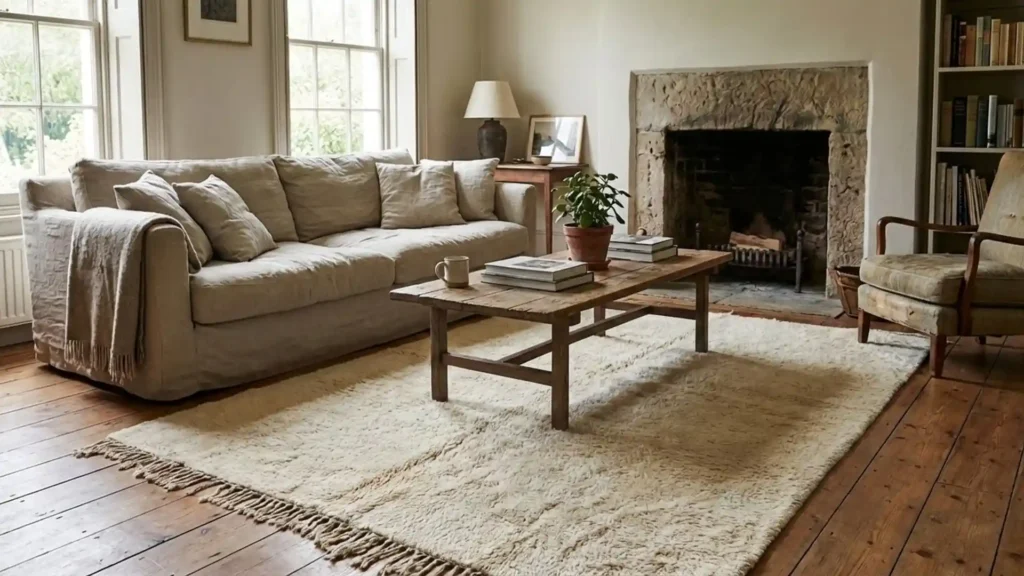
When you bring an authentic Moroccan rug into your home, you’re participating in a story much larger than interior decoration. You’re supporting the continuation of artistic traditions that have survived centuries of change. You’re providing tangible economic impact to women artisans whose livelihoods depend on this work. You’re choosing quality, authenticity, and meaning over disposable mass production. You’re creating a potential heirloom that may be enjoyed by children and grandchildren not yet born.
Every time you walk across your Moroccan rug—feeling the plush wool beneath your feet, noticing how the light catches differently on hand-spun fibers, seeing new details in patterns you’ve looked at hundreds of times—you’re touching something touched by hands that learned their craft from other hands stretching back through generations. You’re experiencing beauty created not by algorithm or assembly line, but by human intuition, cultural memory, and individual creative expression.
These rugs don’t just fill spaces—they transform them. They don’t just add warmth—they add meaning. They don’t follow design trends—they transcend them, remaining beautiful and relevant across decades and changing styles. They’re investments in beauty, yes, but also in ethics, sustainability, cultural preservation, and the irreplaceable value of human craftsmanship in an increasingly automated world.
Your Next Steps: Finding Your Perfect Rug
Perhaps you’ve been inspired to begin your own journey into Moroccan Berber rugs. Here’s how to move forward thoughtfully:
Educate yourself: You’ve taken a significant step by reading this comprehensive guide. Continue learning about specific tribal styles, weaving techniques, and quality markers. The more you understand, the more confident and satisfied you’ll be with your eventual selection.
Define your needs and preferences: Consider your space, lifestyle, aesthetic preferences, and budget. Do you gravitate toward minimalist neutrals or vibrant colors? Do you need durability for high-traffic areas, or luxury for a serene bedroom? What size works in your space? What investment level is comfortable?
Explore reputable sources: Browse collections from dealers committed to authenticity, fair trade, and direct artisan relationships. Look for detailed provenance information, quality photography showing rug details, and transparent pricing.
Ask questions: Reputable sellers welcome inquiries about specific rugs, tribal origins, weaving techniques, condition, and care. Don’t hesitate to reach out for personalized guidance—selecting the right rug is an important decision worthy of expert consultation.
Trust your response: Ultimately, the “right” rug is the one that speaks to you emotionally. Technical knowledge about knot density and tribal origin matters, but your visceral response to a piece’s beauty, energy, and presence matters more. When you find a rug that makes your heart respond, that’s the one.
Begin Your Collection Today
At Berber House Rugs, we’ve dedicated ourselves to connecting discerning individuals with authentic handmade Moroccan rugs sourced directly from artisan weavers and cooperatives throughout Morocco. Every piece in our thoughtfully curated collection has been selected for its quality, authenticity, and the story it tells.
We work directly with Berber weaving communities, ensuring fair compensation, transparent sourcing, and the continuation of traditional craftsmanship. When you purchase through our collection, you’re not just acquiring a beautiful rug—you’re supporting the artisan who created it, her family, her community, and the preservation of cultural heritage that deserves to survive and thrive.
Whether you’re drawn to the plush minimalism of Beni Ourain rugs, the vibrant energy of Azilal pieces, the sustainable creativity of Boucherouite textiles, or the historical patina of vintage treasures, we invite you to explore our collection and discover the piece that’s been waiting for you.
Ready to transform your space with authentic Moroccan beauty? Browse our complete collection of handmade Moroccan rugs and find the piece that speaks to your soul. Need guidance selecting the perfect rug for your specific space and style? Contact our team for personalized consultation—we’re here to help you find not just a rug, but a piece of living heritage that will bring beauty, meaning, and warmth to your home for generations to come.
Your floor is waiting for its story. Let us help you find it.